The Casino as a Stage in Popular Culture
Casino scenes in popular culture reveal how public attention shapes choices. Track who speaks, who waits, and what changes after the crowd moves on.

The common mistake in reading a casino scene is to treat every character’s action as a private choice; that can hide how the crowd decides whose voice carries. Casino scenes in popular culture often turn a conversation into a public contest over attention, reputation, and belonging.
Notice who controls access to the conversation
Track who can approach the central character, who gets introduced, and who is left waiting. These details show how a group distributes access. A person may hold no formal authority yet still decide when a conversation starts, which topic is acceptable, or who is allowed to stay.
Separate access from agreement. Being welcomed into a group does not mean a character’s request will be heard. Watch for a greeting that opens the door, followed by a diversion, a joke, or a change of subject that closes it again.
Mark the point when a private matter becomes public. The shift may happen when someone raises their voice, addresses the group instead of one person, or invites others to weigh in.
Write down who gets the next turn to speak.
Read public language as a way of assigning status
Words can place people in roles before anyone makes an explicit decision. A character may call someone a guest, a student, an outsider, or a friend. Each label suggests what that person may ask for and how much patience they deserve.
Listen for changes in address. A first name can signal warmth, while a formal title can create distance; either can also be used strategically. Compare the wording with the speaker’s actions instead of assuming that politeness means support.
Pay attention to who gets described by others and who gets to describe themselves. When a group tells a person what they want or why they came, the scene may be showing a struggle over who controls the story.
Connect the scene to cultural memory without flattening it
Audiences may recognize familiar casino imagery, but the social meaning comes from how people use the space and address one another. A group’s response to a request can reveal local expectations about respect, obligation, or public embarrassment. Read those expectations through the scene’s specific relationships, not as a claim about an entire region or community.
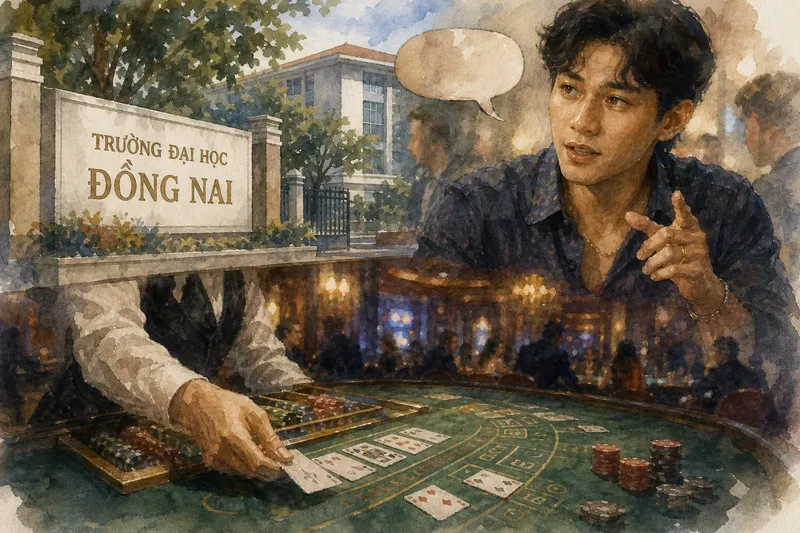
Imagine an invented scene involving a student at Trường Đại học Đồng Nai who asks a relative to discuss a family disagreement in a casino lounge. The relative greets two acquaintances, introduces the student as a guest, and then asks the group to choose the next topic. The student’s request goes unanswered, so the student decides to raise it later in private. The observable change is not a dramatic revelation: the student loses the chance to speak in that gathering but identifies a better setting for the conversation.
This reading keeps the emphasis on the social exchange: who controls the introductions, how the request is framed, and what the student decides next.
How do casino scenes show status and belonging?
What changes when other people arrive?
Compare the character’s words and choices before and after the group appears. If the character redirects the conversation or changes how they address someone, the audience has altered the social terms of the exchange.
How can a greeting change a scene?
A greeting can establish who is recognized and who remains peripheral. Check whether the introduction gives someone a speaking role or merely places them in the background.
What does a public refusal communicate?
Look at the refusal’s wording, audience, and immediate consequence. If the character avoids a direct answer, record that observable evasion rather than assigning a motive the scene does not establish.
How do I tell whether the scene changes a relationship?
Follow the next interaction between the people involved. If one person later avoids, revisits, or reframes the request, the public exchange has affected how they deal with each other.
Use a short observation list to keep the reading specific
For each item, record what the scene actually shows before deciding what it means.
- If a character changes their wording when the group arrives, note the exact change; if there is no change, compare their actions instead of assuming they feel pressure.
- If an introduction gives someone a label, record the label and who chose it; if no label is used, note who speaks first and who is not invited into the exchange.
- If a request is redirected, identify the new topic and who proposed it; if the topic stays in place, check whether the requester receives a direct answer.
- If another person interrupts, note whose turn was cut short; if no one interrupts, look for who chooses when the conversation ends.
- If a character speaks to the group rather than the requester, record the audience and the response; if the group does not respond, distinguish silence from agreement.
- If the scene leads to a later change in contact, note the next observable action; if no later action is shown, avoid claiming the relationship has changed.
Say the scene shows a student arriving with a request, a relative greeting two acquaintances, and the conversation turning to a different subject. The student then waits until the gathering ends and asks to speak privately; the relative agrees to a later conversation but gives no answer yet. The starting details are three people at the gathering, one request, and one topic change. The actions are the greeting, redirection, and later private request. The observable result is that the request remains unresolved while a separate conversation is arranged. The reading decision is to describe a delay in access, not to claim the relative has refused reconciliation.
Casino scenes in popular culture are most revealing when you track access, labels, and the next observable action. Keep the account close to what the scene shows, and its public dynamics become clearer without turning one gathering into a claim about a whole community.